
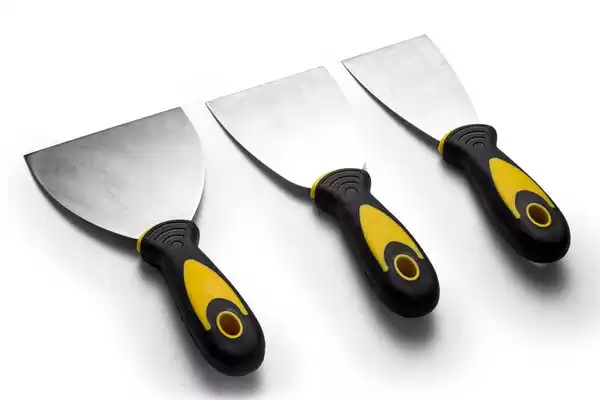
Putty knives, also known as spackle knives or scraper knives, are typically produced through a manufacturing process involving several steps. The specific details can vary depending on the materials used and the desired features of the final product. Here is a general overview of how putty knives are commonly produced:
Material Selection:
The blade of putty knives is often made from high-carbon steel or stainless steel. High-carbon steel provides strength and durability, while stainless steel offers resistance to corrosion.
The handle can be made from various materials such as wood, plastic, or rubber, depending on the manufacturer’s preference and the intended use of the putty knife.
Cutting and Shaping:
The blade material is cut and shaped into the desired form for the putty knife. This may involve stamping, laser cutting, or other precision cutting methods.
The blade typically has a flat, wide shape with a beveled edge to facilitate the spreading and smoothing of putty or other materials.
Heat Treatment:
The blade undergoes a heat treatment process to achieve the necessary hardness and toughness. This involves heating the steel to a specific temperature and then cooling it in a controlled manner.
Grinding and Sharpening:
The blade is ground and sharpened to achieve the desired edge. This step is crucial for ensuring the putty knife effectively spreads and smoothens putty or other materials.
Handle Attachment:
If the handle is made separately from the blade, it is attached to the blade. Handles can be attached using various methods, such as riveting or welding, depending on the design and materials.
Surface Coating (Optional):
Some putty knives may undergo a surface coating process to enhance corrosion resistance or provide other specific properties. For example, a non-stick coating may be applied to make it easier to clean the blade.
Quality Control:
Each putty knife undergoes quality control checks to ensure it meets the manufacturer’s specifications. This may involve checking dimensions, sharpness, and overall build quality.
Packaging:
The finished putty knives are then packaged and prepared for distribution. Packaging may include protective covers for the blade and information on proper use and maintenance.
It’s important to note that variations exist among manufacturers, and some steps may differ based on the specific design and materials used in the production of putty knives.
Post time: Jan-08-2024